Array Sizing Worksheet
Use this worksheet to figure the total number of solar modules required for your system. Or if you have already selected the solar modules you want to use, go to the bottom of this page to see how to predict your electricity generation.
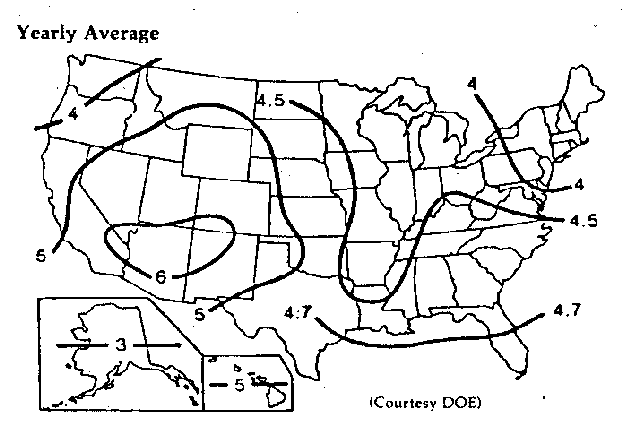
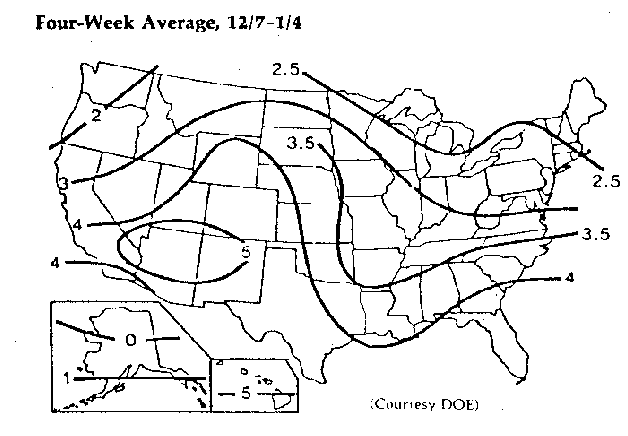
To find average sun hours per day in your area (line 3), check local weather data, look at the maps below or find a city on the next page that has similar weather to your location. If you want year-round autonomy, use the lowest of the two figures. If you only want 100% autonomy in summer, use the higher figure.
The peak amperage of the module you will be using can be found in the module specifications. You can also get close enough if you divide the modules wattage by the peak power point voltage, usually 17 to 18.5).
- Total average amp-hours per day from the System Loads Worksheet, line 10.
________
- Multiply line 1 by 1.2 to compensate for losses in battery charge/discharge.
________
- Average sun hours per day in your area.
________
- Divide line 2 by line 3. This is the total solar array amps required.
________
- Optimum or peak amps of solar module used. See module specifications.
________
- Total number of solar modules in parallel required. Divide line 4 by line
5.
________
- Round off to the next highest whole number.
________
- Number of modules in each series string to provide DC battery voltage
(i.e. 12V = 1 module, 24V = 2 modules, 48V = 4 modules)
________
- Total number of solar modules required. Multiply line 7 by line 8.
________
Electricity Generation Worksheet
Given the total peak watt rating of all your solar PV modules use the worksheet below to estimate the electricity production per day.
Total peak watts of all the PV modules
________Enter the average, low or high sun hours per day in your area
________Multiply line 1 by line 2 to get total watt hours per day generated by modules
________Enter 1.2 if you are using a system with batteries, or 1.1 if you are
using a grid tie system without batteries (to compensate for losses)
________Divide line 3 by line 4 to get net useable electricity generated
in watt hours per day
________Divide line 5 by 1000 to get kilowatt hours (KWH) generated per day
________
If you are designing a grid-tied solar PV system, line 6 is the electricity reduction that you should see on your utility bill usage (on average).
